Colorado's Office Furniture Experts Who Actually Show Up
Colorado's Office Furniture Experts Who Actually Show Up
Colorado's Office Furniture Experts Who Actually Show Up
Based in Denver and Colorado Springs, serving businesses throughout Colorado with space planning, office furniture, delivery and professional installation.

Calling All Bad Backs: The Science of Seating
by Jeff Schwankl, Business Development
If you spend more than four hours a day at a desk, your chair isn’t just furniture … it’s a piece of health equipment. Many people don’t realize the importance of an office chair properly calibrated to their body. If you’re looking for ‘ergonomic office chairs for back pain near me’, and you’re in Denver or Colorado Springs, you’re in the right place!
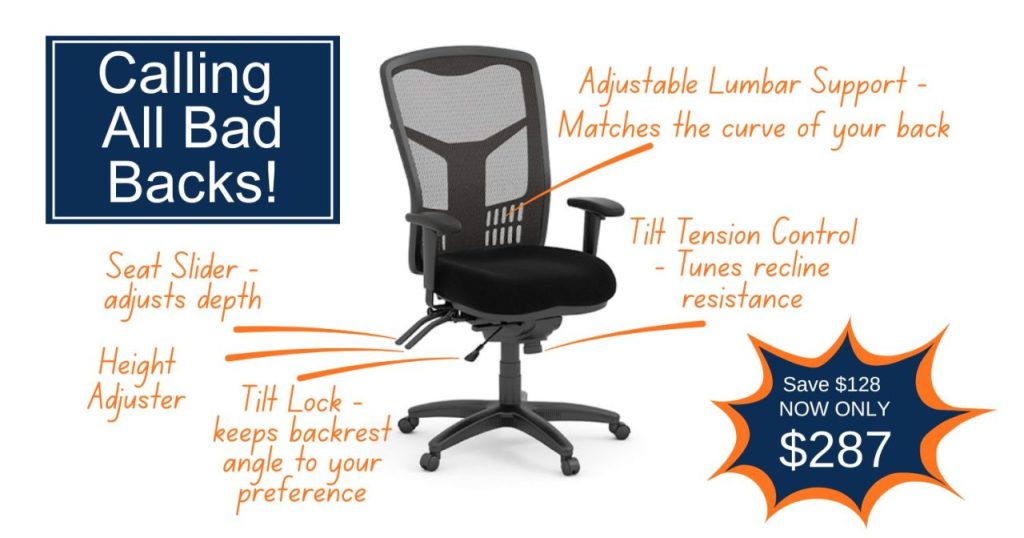
Modern ergonomic chairs are designed to be “active” seating. They shouldn’t just be sat in; they should be adjusted to fit your unique frame. Here is how the specific adjustments on our featured mesh-back task chair work to protect your spine:
1. Adjustable Lumbar Support
Why it matters: Your lower spine has a natural inward curve. Without support, most people eventually slouch, which flattens this curve and puts immense pressure on your lumbar discs.
The Impact: This adjustment allows you to align the chair’s support with the small of your back. By matching the curve of your spine, you reduce muscle fatigue and keep your back in its strongest natural position.
2. Seat Slider (Depth Adjustment)
Why it matters: This is a big one. The length of your thighs determines how deep your seat should be. If the seat is too deep, it can cut off circulation at the knees. On the other hand, if it’s too shallow, it doesn’t support the weight of your legs properly.
The Impact: By sliding the seat forward or back, you ensure your back stays firmly against the lumbar support while leaving a small, healthy gap behind your knees to optimize blood flow.
3. Tilt Tension & Tilt Lock
Why it matters: “Static” sitting (staying in one frozen position) is the enemy of back health. Tilt Tension controls how much effort it takes to recline. The Tilt Lock keeps you at a specific angle.
The Impact: Proper tension allows you to move slightly throughout the day—a “rocking” motion that helps keep spinal discs hydrated. The lock is vital for switching between a focused, upright typing position and a relaxed recline for reading or phone calls.
4. Pneumatic Height Adjustment
Why it matters: If your feet aren’t flat on the floor, your lower back bears the weight of your legs. If your chair is too low, your knees sit higher than your hips, tilting your pelvis backward and straining the spine.
The Impact: Correct height ensures your elbows are at a 90-degree angle to your desk and your feet are fully supported. This takes the “pull” off your lower back muscles.
Experience the Difference in Person
Buying a chair online is a gamble for your back. Every body type is unique, and “one size fits all” rarely works for chronic pain.
We invite you to visit Office Furniture EZ at our Denver or Colorado Springs showrooms. You can “try before you buy,” and our specialists will give you a personalized fitting to show you exactly how to adjust these features for your specific posture needs.
Need help? Have a question?
Looking for a price quote?
Request Space Planning Help