Colorado's Office Furniture Experts Who Actually Show Up
Colorado's Office Furniture Experts Who Actually Show Up
Colorado's Office Furniture Experts Who Actually Show Up
Based in Denver and Colorado Springs, serving businesses throughout Colorado with space planning, office furniture, delivery and professional installation.

Office Furniture Terms and Definitions
The Secret Language of Office Furniture: A Translator of Terms and Definitions for the Rest of Us
By Tim Schwankl
As office furniture experts, we sometimes forget that our customers don’t know all of the lingo that’s tossed around on the job site. Some of it can sound a little off the beaten path – words like “creeps” and “peds”. Rest assured, it’s all legit. However, this gave us an idea to put together a little list of some of the things commonly said during the process of planning a space, delivering to the site, and setting up the furniture.
Without further ado, here’s our glossary, organized by the different stages of the project management process.
Layout Terms
Commercial Office Furniture: This is furniture built for the all-day grind in an office. While home office furniture is made for light use, commercial grade is over-engineered to handle 40+ hours of use a week and withstand heavy cleaning.
Modular Office Furniture: Think of this as LEGOs for adults. It’s office furniture designed to be snapped together, taken apart, and rearranged. If your team grows, you can reconfigure the pieces instead of buying all new stuff.
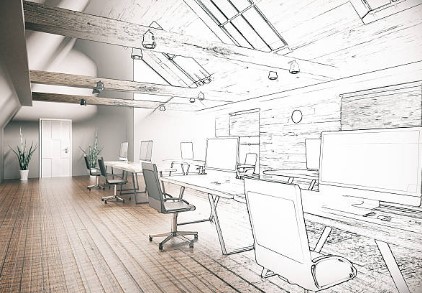
Open Plan: An office layout with very few private offices or floor-to-ceiling walls. Instead, it’s a wide-open floor where everyone sits in the same general area to encourage collaboration.
Desking: A specific layout that uses long, continuous rows of tables rather than traditional high-walled cubicles. It aims for a cleaner, more modern look.
Benching: The same as desking. A long continuous work surface shared by multiple employees.
Hoteling: Instead of having a permanent desk, you reserve (in some cases) and check into to a workstation for the day as needed. It’s a great solution for teams with hybrid or remote employees.
Design & Planning Terms
CAD (Computer-Aided Design): These are the technical blueprints for your office. It’s a precise digital map that installers use to know exactly where every single screw and panel goes.
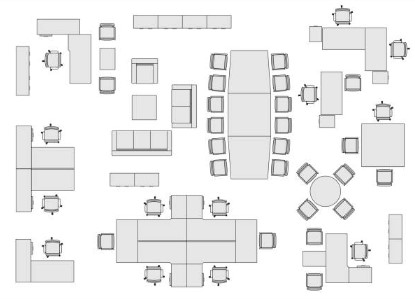
2D Rendering: This is the bird’s-eye view. It’s a flat, top-down drawing of your floor plan. It’s great for seeing if furniture physically fits in the room. This is what the folks paying for the furniture usually want to see.
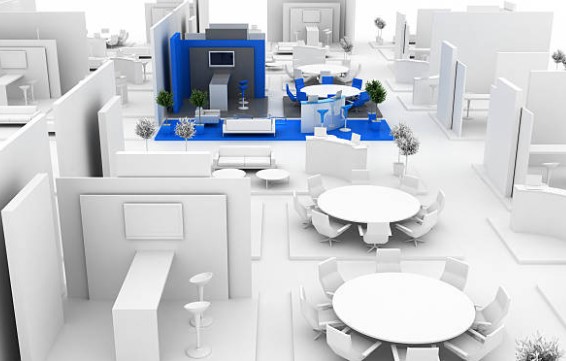
3D Rendering: This is the virtual version of your future office. It’s a lifelike digital picture that shows colors and textures so you can see your office before you buy it.
Panel Creep: When you snap cubicle panels together, they gain a tiny bit of width at every connection. If you have a long row of desks, “creep” can make the last one a tight fit!
Demountable Walls: These look like permanent glass or solid walls, but they can be taken down and moved to a different part of the office without a construction crew.
Product Terms and Definitions
Casegoods: A broad term for any furniture made of hard materials like wood, laminate, or metal. If it’s a desk, bookshelf, or cabinet and it isn’t upholstered, it’s a casegood.
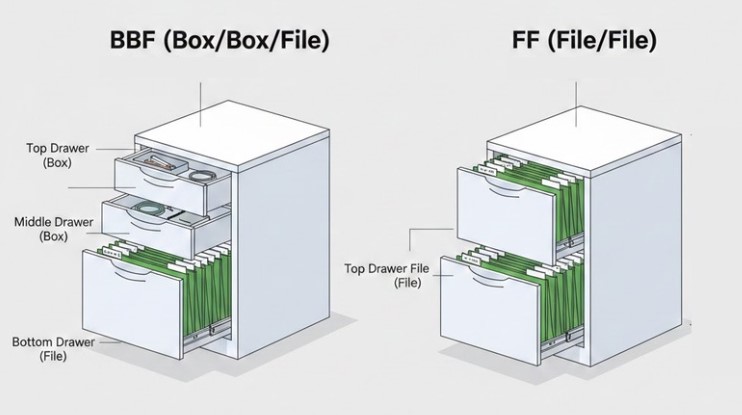
The Ped (Pedestal): The industry name for those small filing cabinets that sit under a desk. You’ll usually hear them called “BBF” (Box/Box/File) or “FF” (File/File) based on the drawer layout.
Credenza vs. Hutch: A Credenza is the low storage unit that sits behind a desk. A Hutch is the shelving unit that sits on top of the credenza.
Bridge: The connecting piece of wood or laminate that turns a single desk and a credenza into a “U-shaped” workstation.
Modesty Panel: The board or fabric piece that hangs down at the front of a desk to block the view of your legs and messy cables from people walking by.
Bullet Top (or P-Top): A desk surface rounded on one end like a bullet or the letter P. This feature allows you to hold quick meetings right at your desk.
The Spine: The “backbone” of a cubicle layout. It’s the main, long line of panels that carries all the electrical wires and data cables to the desks.
Grommet: That plastic or metal ring inside the hole on your desktop. It protects your cords from potential damage.
Power Whip: The thick, heavy-duty cable that connects an entire row of cubicles to the building’s main electrical power supply.
Return: The part of a desk that attaches to the main part at a 90 degree angle in an L-shaped workstation. Therefore, a left return is when the return is to the left of the main portion of the desk and the right is on the right side of the main desk – from the perspective of the person seated at the desk.
Logistics Definitions
BIFMA: This stands for the Business and Institutional Furniture Manufacturers Association. They put furniture through “torture tests” to ensure it can handle heavy, daily use without breaking. Furniture that’s BIFMA rated is tough and built to last.
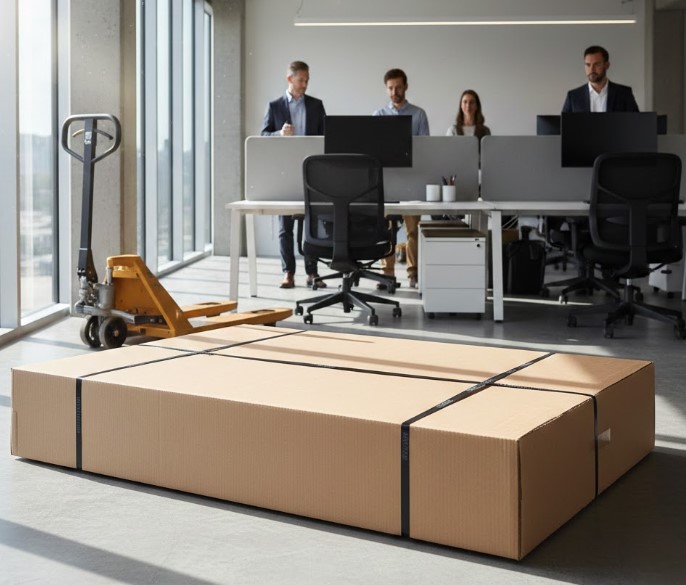
Knocked Down (KD): The professional way of saying “Some assembly required.” So, if a desk arrives KD, it will be in a flat box and will need to be put together on-site.
Lead Time: The waiting period between when you place an order and when the furniture actually arrives at your door.
Punch List: The “to-do” list at the very end of an installation. It’s where you write down small fixes, like a squeaky drawer or a missing shelf clip.
Ready to start your office project?
Now that you speak the language, let’s put it to use. Need a 3D rendering and an estimate? Can do! Want to discuss desking options for hybrid employees? We’re ready when you are. Want to stop in and see some furiture in person before you decide? We’re here weekdays 9AM to 4PM.
Book Your Site Survey now to get a no-obligation, no cost quote at your business.

Need help? Have a question?
Looking for a price quote?
Request Space Planning Help